Reflections from the Mental Health & Overmedicalization Summit
By Cooper Davis, Executive Director of Inner Compass Initiative
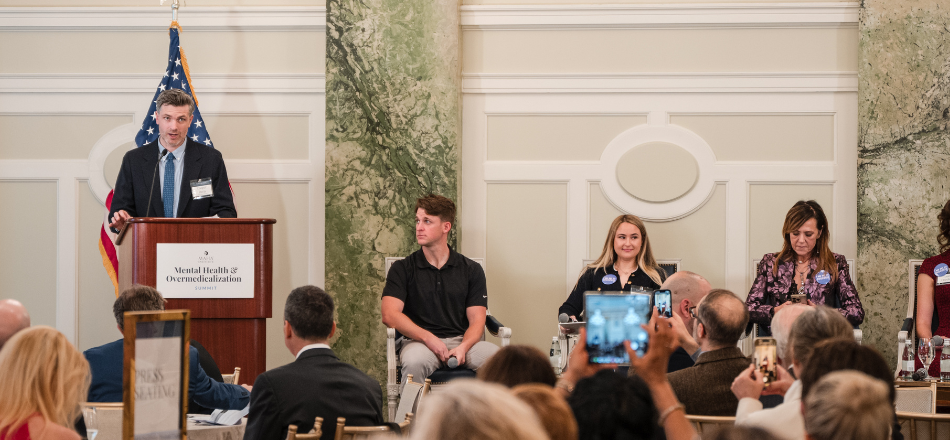
On May 4th, Inner Compass Initiative had the opportunity to help coordinate and participate in the Mental Health & Overmedicalization Summit in Washington, D.C. The gathering brought together policymakers, researchers, clinicians, advocates, and individuals with lived experience for a day of conversation about the current state of mental health care in the United States — and where it may be headed next.
For many years, these conversations have remained largely outside official channels. In this moment, however, perspectives long pushed to the margins were invited into direct conversation with federal leadership.
We had the rare opportunity to bring together layperson expertise, clinical insight, research, and policy perspectives in a way that reflected both depth of personal experience and the realities people are navigating every day on a bigger stage than ever before.
Inner Compass Initiative played a key role in helping shape the Summit’s programming, working to ensure that discussions reflected the longstanding history of critical research into medicalization and the breadth of expertise held by current and former patients, families, clinicians, and researchers. Participants included Inner Compass Research Institute Senior Fellows David Cohen, Ph.D., Gretchen LeFever Watson, Ph.D., and Jeffrey Lacasse, Ph.D., alongside many others who have spent decades engaging these issues from different angles.
Throughout the day, discussions reflected a growing recognition of concerns that ICI has been elevating for over a decade: that experiences such as grief, anxiety, trauma, and distress are increasingly being framed through a strictly medical lens, often without sufficient consideration of context, meaning, or long-term outcomes.
As advocate and former FDA Advisory Committee Member Kim Witczak stated during the Summit:
“For the first time in decades, harmed patients and lived experience were not dismissed or ignored by government leadership. They were acknowledged, validated, and finally brought into the conversation.”
What emerged from the gathering was significant. HHS Secretary Robert F. Kennedy Jr. announced a series of initiatives aimed at addressing psychiatric overprescribing, expanding support for safe deprescribing, strengthening informed consent, and increasing access to non-pharmacological approaches to care.
For many people in attendance, the emotional weight of the moment was palpable. Mark Horowitz, MD, Ph.D., lecturer at King’s College London and resident psychiatrist, reflected afterward:
“I think the reason that the event brought so many people to tears was to see recognition of the seriousness of psychiatric drug withdrawal at the highest levels of the government combined with the promise that something might finally be done about this massive public health issue, which has been minimized and denied for so many decades.”
At the same time, the significance of this moment does not rest in announcements alone. What matters now is what follows: whether informed consent becomes standard practice, whether people have real access to safe, hyperbolic tapering support, and whether non-pharmacological and community-based options become truly available.
For a long time, this conversation lived on the margins, carried by people who didn’t ask to be here, but had no choice because of what they went through. What felt different about this moment is that those voices were taken seriously in rooms that actually shape policy. We’ve been pushing in this direction for over a decade, and what we saw here felt like the gears starting to catch.
Now the question is whether that momentum turns into real change for the millions of people living this every day.
At Inner Compass Initiative, our focus remains on helping people make informed choices about taking and safely tapering off psychiatric drugs while working to shift culture, science, and policy away from default medicalized responses to human experience. That work continues through education, dialogue, research, and practical resources, including our free taper guide and peer support initiatives.
We are encouraged by this moment. But we also understand that moments like this are fragile. Meaningful change requires continued public engagement, sustained pressure, institutional courage, and long-term support.
This next phase of the work will require continued investment. If you believe these conversations belong at the policy table — and that lived experience, informed choice, and open inquiry should remain central to the future of mental health care — we would be deeply grateful for your support.
Thank you for being part of this work. We could not do it without you.
- Log in or join one of our Connect networks to comment