
DSM Updates—Bias and Biomarkers
By Carrie Clark
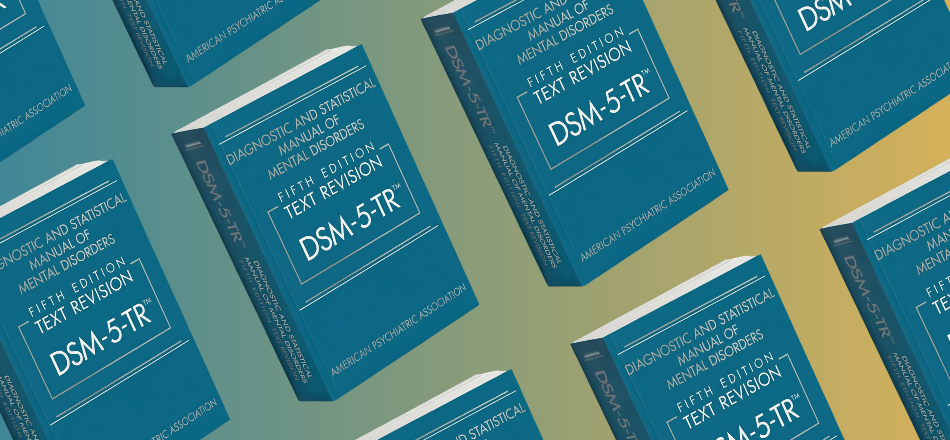
The American Psychiatric Association (APA) has announced updates to the Diagnostic and Statistical Manual of Mental Disorders (DSM). The DSM is the leading text used to diagnose mental health conditions, selling around 100,000 copies per year and earning the APA a hefty profit. DSM-IV and its offshoots are thought to have netted the Association $100 million.
The decision makers who work on the DSM are often clinicians in receipt of funds from the pharmaceutical industry, raising questions about conflicts of interest that will be wearily familiar to everyone involved in the mental health reform movement. It seems that DSM-6 will be no exception. Dr James Davies reports that Maria Oquendo, chair of the Future DSM Strategic Committee, owns stock in pharmaceutical company Bristol-Myers Squibb and receives funding from no less than seven pharmaceutical firms.
“The DSM has been beset by problems ever since its inception.”
Originally created with the goal of standardizing the diagnostic process and bringing psychiatry in line with other medical disciplines, the DSM has been beset by problems ever since its inception. Most of these arise from the fact that experiences of mental and emotional distress are unlike the physical ailments treated in other fields of medicine. We cannot diagnose depression using a blood test or perform an X-ray to verify whether someone has schizophrenia.
New diagnoses or changes to existing DSM criteria are therefore proposed on the basis of patterns that clinicians perceive in the behavior of their patients. Proposals are voted on by committees of relevant experts convened by the APA. If a majority vote in favor, then a new diagnosis is born, willed into existence by little more than the intuitions and preferences of the committee members. Psychologist Renee Garfinkel, who sat on two DSM committees, described the process as follows:
What I saw happening on these committees wasn’t scientific—it more resembled a group of friends trying to decide where they want to go for dinner. One person says “I feel like Chinese food,” and another person says, “No, no, I’m really more in the mood for Indian food,” and finally, after some discussion and collaborative give-and-take, they all decide to go have Italian.
Similarly, asked why the diagnostic criteria for depression required patients to experience five symptoms, rather than four or six, to qualify for the diagnosis Dr Robert Spitzer, Chair of the DMS-III explained that:
It was just consensus. We would ask clinicians and researchers: “How many symptoms do you think patients ought to have before you would give them the diagnosis of depression?” And we came up with the arbitrary number of five.… Four just seemed like not enough. And six seemed like too much.
This means that it’s not clear whether the diagnoses listed in the DSM actually represent meaningful categories. This isn’t to question the reality of the mental and emotional distress experienced by patients or even the need for a conceptual framework to guide optimal treatment decisions. It’s simply to observe that the way the DSM categorizes distress appears arbitrary and epistemologically unsound. There is an air of unreality about the way psychiatry’s central text goes about defining diagnostic categories, and this is particularly concerning given that DSM diagnoses are ultimately used to justify psychiatric interventions that can have life-altering consequences.
Supporters of the DSM have argued that all this subjectivity is a necessary evil, an interim measure until objective biomarkers for mental health conditions are inevitably identified. The APA update sets out plans to create a system for validating and incorporating such biomarkers into future DSM-6 diagnostic criteria. However, an accompanying commentary titled “The Future of DSM: Role of Candidate Biomarkers and Biological Factors” makes it clear that the APA may be getting a little ahead of itself, admitting that no reliable biomarkers have actually been identified:
[N]o biomarkers have had the needed specificity and sensitivity for use in routine psychiatric diagnosis and…well-defined pathophysiological mechanisms for psychiatric disorders are lacking.
As the commentary sets out the latest research on proposed psychiatric biomarkers, its authors are obliged to qualify every claim they make. Techniques using EEG “may improve diagnostic validity.” Genetic markers “may enhance diagnostic accuracy” (italics added). Studies of neurocircuitry “may…offer clinicians and researchers a therapeutic path forward” (italics added). Inflammatory markers “may be a good place to start for identification of depression subtypes” (italics added). No claim can be left unqualified, because none of the proposed biomarkers are so far supported by evidence of clinical relevance or diagnostic utility.
When the DSM was first published in 1952, it might have been reasonable to claim that subjective diagnostic criteria were merely a temporary placeholder until scientific progress revealed more objective biomarkers. But over 70 years later and with no biomarkers in sight, it is beginning to seem more like a combination of willful blindness and wishful thinking. It’s also a waste of resources that might otherwise be invested in researching more plausible frameworks for understanding the causes of mental and emotional distress.
“Mental health conditions are more likely to be caused by difficult life events and sociocultural circumstances than faulty neurotransmitters or genetic deficits.”
Mental health reformers like Lucy Johnstone and John Read point to the wealth of evidence showing that mental health conditions are more likely to be caused by difficult life events and sociocultural circumstances than faulty neurotransmitters or genetic deficits. Johnstone’s Power Threat Meaning Framework gives a compelling account of this evidence, and the APA update suggests that the psychiatric establishment is increasingly aware that it must account for these critiques. Two additional commentaries set out the intention for DSM-6 to integrate environmental and sociocultural factors into revised diagnostic criteria, taking greater account of a patient’s quality of life and functioning.
It will be interesting to see whether this more holistic approach to diagnosis translates into more holistic approaches to treatment. DSM diagnoses may be subjective constructs, but in practice they are used to justify psychiatric treatments that have highly objective effects. These include physical dependence and withdrawal in addition to adverse effects like tardive dyskinesia, post-SSRI sexual dysfunction, and akathisia. Conventional psychiatry has defended the use of such treatments on the basis that they act on the underlying biological causes of mental health conditions. But if a condition like depression is actually caused by adverse social circumstances rather than a “chemical imbalance,” it becomes harder to justify prescribing antidepressants, particularly given mounting awareness of their poor efficacy.
Perhaps this is why identifying “biologically grounded diagnostic categories” for the DSM remains the central goal of the APA, despite the nod to individual and sociocultural factors in this update. If psychiatry ever admits that biomarkers are a ghost in the machine, it will have difficult questions to answer about the treatments it has recommended. It’s not clear that the profession is ready for that reckoning.
- Log in or join one of our Connect networks to comment